
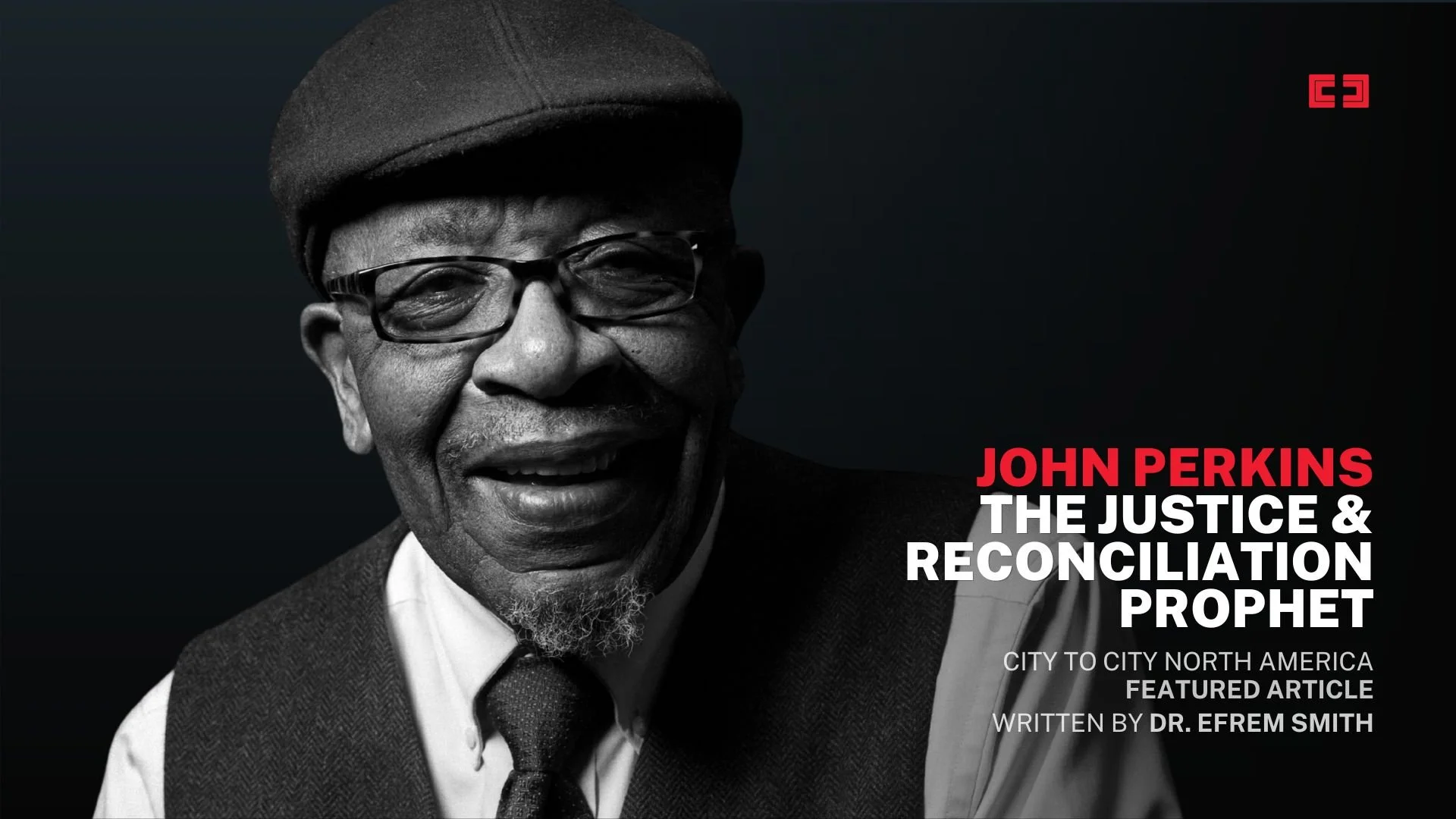
Recently, the world lost a great evangelist, catalyst for Christian Community Development, and a theologian who articulated a deep biblical understanding of the gospel for a racially divided nation. I first heard Dr. John Perkins preach as a teenager at the Soul Liberation Festival—an outdoor revival of sorts put on by Park Avenue United Methodist Church of Minneapolis in the late 1980s. I was in awe of this small but powerful Black preacher, hunched over with his eyes closed, presenting reconciliation as the central idea of the gospel of Jesus Christ.
“Would I choose a justice-oriented and liberative disciple-making agenda, or a reconciling, multiethnic disciple-making community? John Perkins helped me understand I didn’t have to choose.”
Though I was already a Christian and had been baptized as a child, I found myself at the altar (or at least the front of the stage) after that sermon. I had another conversion experience that day. I sensed a call to justice, reconciliation, and the church. There was a seed planted in me that would lead towards a call to ministry a few years later. I felt the convergence of the liberating theology of the Black church and a justice-oriented and disciple-making expression of evangelicalism. Soon after that, my youth pastor told me about With Justice for All, one of the books by Perkins I read as a college student which led me to begin wrestling with my call to ministry.
As a product of both the Black church and Midwestern evangelicalism, I have wrestled over the years of whether my pastoral call was to the multiethnic church or the Black church. I have a deep passion and burden for both. After all, I am a Black Christian and I learned to preach, sing, and form a liberating Black Christian identity in the Black church. But I was also experiencing my own burning bush moment regarding the multiethnic and urban church. I gained a deeper understanding of Revelation 7 and its picture of heaven as a Christ-centered, eternal community with a great multiethnic multitude. As the apostle Paul presents in 2 Corinthians 5, Christ reconciles us to God and one another. Sinful social divides are addressed through the death and resurrection of Christ.
So, with these two passions burning in my soul, would I choose the Black church or the multiethnic? Would I choose a justice-oriented and liberative disciple-making agenda, or a reconciling, multiethnic disciple-making community?
John Perkins helped me understand I didn’t have to choose. This Black man of the Deep South almost lost his life because he cared about Black people coming to know Christ as Lord and Savior and having the right to live as full American citizens, including the right to vote. This duel mission ended up putting him at the hands of members of law enforcement who beat him within an inch of his life.
But as he recovered in a hospital bed, his combination of evangelism and civil rights would turn into a gospel-based trinity with the addition of reconciliation. Through the power of the Holy Spirit, the healing of God the Father, and connecting to a deeper identity in Christ, Perkins found a way to forgive those who tried to take his life. In a hospital bed, he joined Christ on the cross when he asked his Heavenly Father to forgive those who were crucifying him.
John Perkins become a liberation reconciler. That combination is both dynamic and difficult to live out. John Perkins was a wonderful embodiment of biblical ideas that have been bifurcated and used to justify the homogenous church in the United States of America. Perkins’ preaching, writing, and ministry initiatives brought together biblical justice, liberation, reconciliation, and evangelism. His legacy for some may prove too Black for evangelicalism or too evangelical for the Black church. But I would propose that his legacy is a beautiful quilt of the evangelicalism of Billy Graham, the liberation theology of James Cone, the justice-oriented reconciliation of J. Deotis Roberts, and the community development courage of the biblical Nehemiah. This short man from the South presented a tall gospel that ought to be wrestled with until Christ returns. But he showed me that it is possible to carry a passion for both the Black church and the multiethnic church as a whole.
John Perkins was my onramp to justice-oriented, reconciling, liberating, and disciple-making ministry praxis. After encountering him, I would go on to discover Howard Thurman, James Cone, J. Deotis Roberts, Tom Skinner, Cheryl J. Sanders, Brenda Salter McNeil, Zina Jacque, Don Davis, and so many others.
Since that day frontstage at the Soul Liberation Festival, I have served as a youth pastor, Parachurch Urban Ministry Director, Faith-based Foundation Executive Director, Black Church Interim Pastor, Multiethnic Church Planter, Denominational Superintendent, Urban Missions Organization President, and Multiethnic Church Co-Senior Pastor. In each of these roles I have carried a little bit of John Perkins with me. I had opportunities to sit under the teaching of John Perkins over the years. I was blessed to get to know him personally. He spoke to me from the stage, the pulpit, and the chair next to me as he prayed for me and affirmed me before I rose to preach at a conference. I can say that in a season when I was ready to give up on the sustained possibilities of reconciliation and justice addressing the social ills of the nation in which I live or even the racial divides in the Body of Christ, I would end up at a conference with Perkins or at his ministry site in Jackson, Mississippi. There I would receive a word that would give me a second wind to keep going. My last connection with Dr. Perkins was on Zoom as an invited guest to lead his Wednesday Morning Bible Study. When I saw him on the screen, I was so nervous. I was leading a Bible study in the presence of one of the best Bible teachers I have ever known! And now, his race has been run and he is resting well in heaven.
May we continue the work of justice, reconciliation, and disciple-making in this multicultural, politically polarized, and racially divided mission field. The harvest is truly plentiful and there is a need for more justice-oriented and disciple-making laborers. May we see the poor, undocumented, oppressed, and marginalized through the eyes of Christ. May we yearn for our cities to be deeply influenced by the Kingdom of God and not the mentalities of our worldly empires. May we hunger and thirst for the reconciling power of Christ to penetrate the hearts those who believe opposing diversity is somehow connected to the agenda of God. This is how we can honor the life of Dr, John Perkins. Through this, may God’s will be done.
